
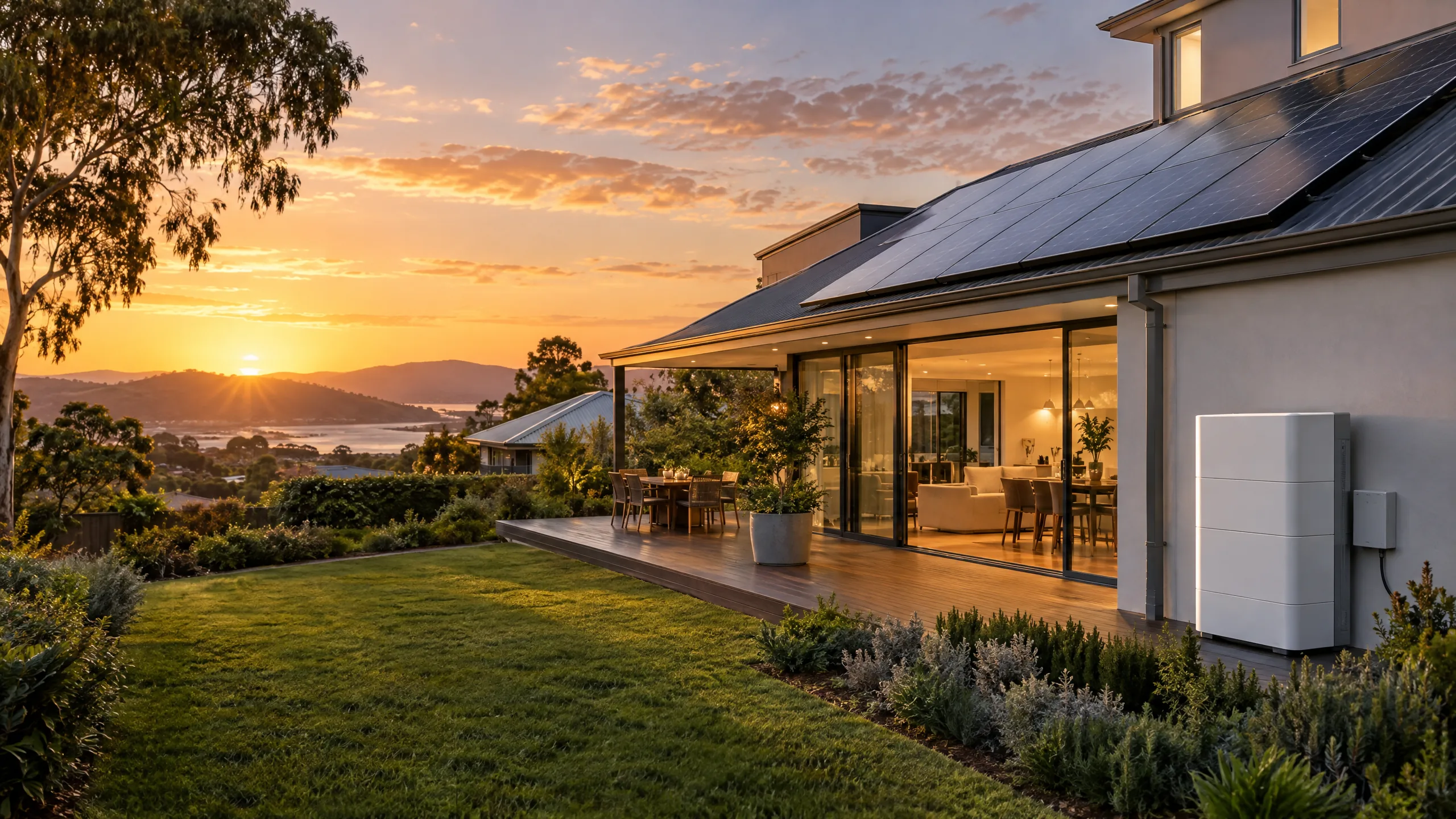
Solar + Battery Packages
Solar and Battery Packages in Victoria
Designed, installed and commissioned together.
Installing solar panels now and a battery later often means paying for two inverters, two electricians and two site visits. A combined package—panels, hybrid inverter and battery designed as one system—costs less to install, runs more efficiently and qualifies for more incentives. We handle the full setup: usage review, compatibility checks, cabling, backup configuration (if you choose it), commissioning and rebate paperwork.
Choose your suburb
Melbourne · West
- Caroline Springs 3023
Melbourne · South East
- Berwick 3806
- Cranbourne 3977
- Clyde 3978
- Narre Warren 3805
- Botanic Ridge 3977
Melbourne · North
- Craigieburn 3064
Melbourne · Inner
- Melbourne 3000
Melbourne · East
- Glen Waverley 3150
- Ferntree Gully 3156
- Croydon 3136
- Wantirna 3152
- Blackburn 3130
- Wheelers Hill 3150
Melbourne · North East
- Epping 3076
- Bundoora 3083
- Mill Park 3082
- Thomastown 3074
- Lalor 3075
- Whittlesea 3757
- Mernda 3754
Geelong area
- Highton 3216
- Torquay 3228
- Armstrong Creek 3217
- Geelong 3220
Ballarat area
- Ballarat 3350
Mornington Peninsula
- Mornington 3931
- Mount Martha 3934
- Mount Eliza 3930
Why install solar and battery together in Victoria?
Victoria's climate—cool winters, hot summers and occasional frost in elevated regions—suits battery storage well. Daytime solar generation peaks in spring and summer, while battery discharge helps offset peak evening demand and protects you during winter outages or high-tariff periods. Installing panels and battery as one system means a single electrician visit, one hybrid inverter, one set of commissioning tests and one warrantied product—not two separate installs spread months apart.
Victorian homes span many ages and roof types. Weatherboard and brick houses (common in suburbs like Footscray, Preston and Coburg) may have older electrical systems requiring switchboard upgrades. Newer brick veneer homes in growth areas (Cranbourne, Pakenham, Werribee) typically have space and simpler wiring. Shared buildings (flats in St Kilda, inner Melbourne) may face body corporate or council restrictions. We assess your specific property before proposing a package, ensuring the design fits your roof orientation, shading from trees or neighbouring buildings, and local council requirements.
The distribution network in Victoria is managed by five regional operators: Ausnet Services (covering the north-east, west and parts of central Victoria), Powercor (the west), and United Energy (the south-east and metro areas). Network upgrades and peak-demand fees differ by postcode, so battery timing and size affect your savings. We factor your local network area and tariff structure into every package design.
⏳ Deadlines
- Cheaper Home Batteries steps down in 38 days (1 January 2027)About $252/kWh for the first 14 kWh, $151/kWh to 28 kWh and $38/kWh to 50 kWh (2026 rate) Source: DCCEEW Cheaper Home Batteries, from 1 May 2026 · checked 2026-10-16
- STC discount on new solar shrinks in 38 days (1 January 2027)about 20% less than this year (one fewer deeming year) Source: Clean Energy Regulator (small-scale technology certificates) · set by law
Local solar data
How much power does solar make in Victoria?
Each kW of panels in Victoria makes about 1,366 kWh a year (Melbourne data). That means a 6.6kW system makes around 9,016 kWh a year, or about 25 kWh on an average day. Melbourne averages 4.8 peak sun hours a day.
Figures use PVWatts modelling for a north-facing (south-facing in the northern hemisphere) roof at 20°. Your actual output depends on shade, roof direction and the panels you choose.
| City | Network | kWh per kW a year | Sun hours a day | Grid price per kWh | Yearly saving, 6.6kW |
|---|---|---|---|---|---|
| Melbourne VIC | — | 1,366 | 4.76 | — | — |
Incentives that apply in Victoria
National · battery
Cheaper Home Batteries
About $252/kWh for the first 14 kWh, $151/kWh to 28 kWh and $38/kWh to 50 kWh (2026 rate)
Battery 5–100 kWh, able to join a VPP, connected to rooftop solar
Source: DCCEEW Cheaper Home Batteries, from 1 May 2026 · checked 2026-10-16
National · solar
Small-scale Technology Certificates (STCs)
Upfront discount: kW × zone multiplier × deeming years × STC price
Systems up to 100kW installed by an SAA-accredited installer
Source: SRES: zone multiplier × 5-year deeming × $38 per STC · checked 2026-10-16
VIC · hot water
Solar Victoria hot water rebate
up to $1,400 locally made, $1,000 other
Same $150,000 income cap
Source: Solar Victoria, from 1 July 2026 · checked 2026-10-16
VIC · solar
Solar Victoria panel rebate
up to $1,400
Combined household income $150,000 or less
Source: Solar Victoria, from 1 July 2026 · checked 2026-10-16
Sources: PVWatts v8 (north-facing 20°, 14% losses, nearest station) · SRES: zone multiplier × 5-year deeming × $38 per STC · DCCEEW Cheaper Home Batteries, from 1 May 2026 · Solar Victoria, from 1 July 2026
How big should my solar battery be?
Can a battery power my home in a blackout?
How long does a home battery last?
What is included in a solar and battery package?
How much do solar and battery packages cost in Victoria?
What is the difference between AC-coupled and DC-coupled battery systems?
Do I need a backup-capable battery system?
What rebates and incentives apply to solar and battery packages in Victoria?
How long does a solar and battery installation take?
What maintenance do solar and battery systems need?
Get a tailored solar and battery quote for your Victorian home.
Contact Bill Saver Solar today. We'll review your bills, assess your roof and explain rebates.